
.png)
Most electric motorbikes rely on conventional wire-wound stator coils. This is a well-established and widely used solution, particularly suited to applications where manufacturing efficiency, supplier availability and process maturity are key considerations.
However, when developing an electric motorbike with a strong emphasis on precision, repeatability and system-level integration, this approach introduces a different set of trade-offs.
BilletFlux™ is Blacksheep Power’s proprietary response to those trade-offs.
MANUFACTURING CONSTRAINTS IN CONVENTIONAL MOTOR DESIGN
In a typical brushless electric motor, electromagnetic fields are generated by copper windings in the stator. These windings are traditionally formed by winding copper wire and require specialised winding equipment and tightly controlled manufacturing processes.
For this reason, many manufacturers source motors from suppliers operating at sufficient scale to support this infrastructure.
When a manufacturer chooses to design a bespoke motor for performance, packaging or integration reasons, this often means adapting an existing motor platform or working within manufacturing processes that prioritise repeatability and throughput over fine-grained control of electromagnetic geometry.
Neither approach is inherently motorbike, but both limit how precisely the electromagnetic system can be engineered around the specific requirements of the motorbike.
LIMITATIONS INHERENT TO WIRE-WOUND STATOR COILS
Wire-wound coils are shaped by the physical properties of copper wire, and the winding process itself. Packing density is constrained, copper cross section is segmented rather than continuous, and small variations between coils are difficult to eliminate entirely.
In higher-performance electric motors, these characteristics influence electrical resistance, heat generation and the consistency of the magnetic field. At scale, these effects are managed through established design margins. In precision-led systems, they become more noticeable.
These are not flaws in the technology, but characteristics of how it is manufactured.
BILLETFLUX™: A BILLET-BASED APPROACH TO ELECTROMAGNETICS
BilletFlux™ applies a billet-based engineering philosophy to the electromagnetic system of the motor.
Instead of winding copper wire, the stator conductors are designed as solid components and CNC machined from billet copper as single, continuous parts. This allows electromagnetic geometry to be defined digitally and reproduced with a high degree of consistency.
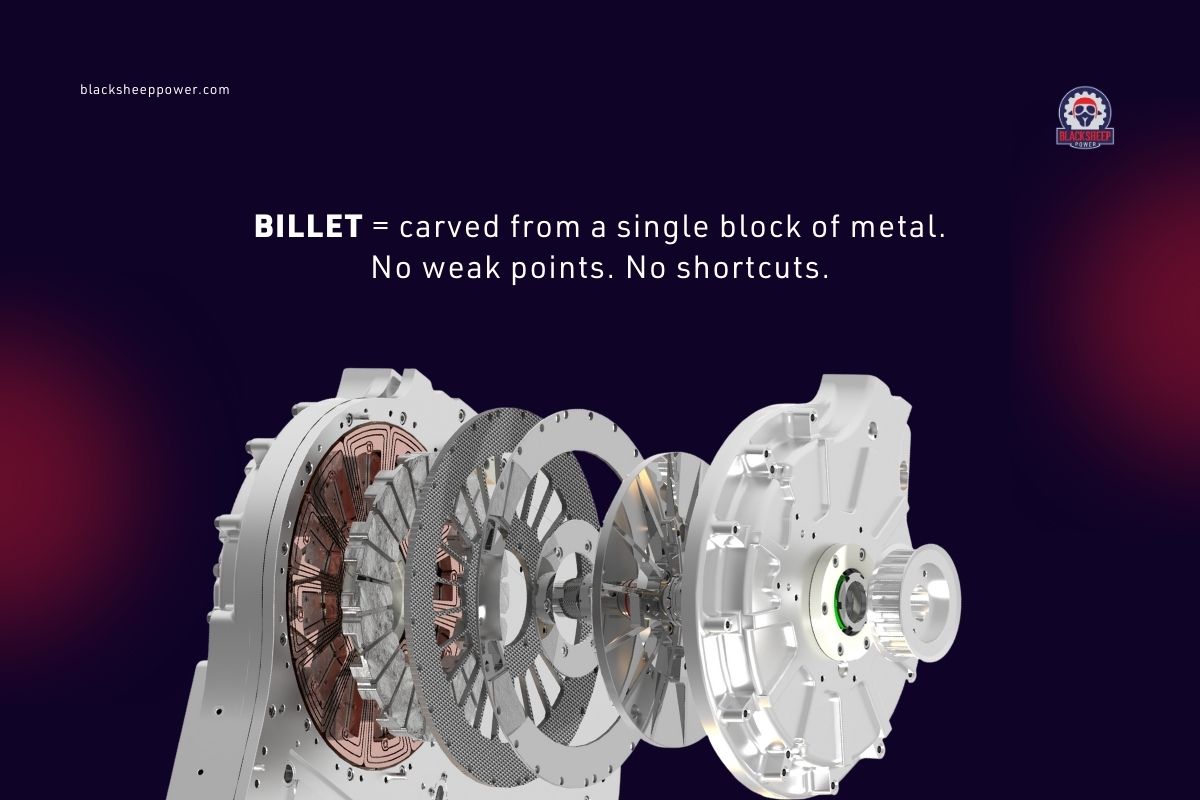
BilletFlux™ enables higher effective copper density within the available volume and more consistent electromagnetic geometry compared to wire-wound stator designs.
Machining coils from billet copper allows:
- greater control over copper cross section within a given volume
- reduced electrical resistance relative to segmented wire paths
- more predictable thermal behaviour under sustained load
- consistent geometry from one motor to the next
The result is a stator design that prioritises repeatability and integration over ease of manufacture.
SYSTEM-LEVEL BENEFITS IN AN ELECTRIC MOTORBIKE
Electric motorbikes deliver torque immediately and continuously. As a result, variations in electromagnetic performance, thermal behaviour or mechanical integration are felt more directly than in many other applications.
By integrating billet-machined stator conductors into the motor architecture, BilletFlux™ supports cleaner power delivery, improved thermal stability and reduced variability between motors.
Rather than functioning as a generic subsystem, the motor becomes a tightly engineered part of the motorbike as a whole.
WHY BILLETFLUX™ MATTERS
BilletFlux™ is not an incremental optimisation of existing electric motor designs. It represents a different approach to how electromagnetic systems are conceived and manufactured.
.jpg)
By replacing wire-wound conductors with billet-machined copper components, Blacksheep Power introduces a level of geometric control, repeatability and system integration that is not achievable within conventional motor manufacturing frameworks. This approach increases engineering complexity and manufacturing demands, but it also enables levels of consistency and control that standard architectures cannot provide.
This is why BilletFlux™ is a patented technology: because it departs meaningfully from established motor design and manufacturing methods.
The Blacksheep ONE exists because this level of engineering difference exists.
.png)


